
|
My research interests |
My research interests span a broad spectrum of aquaculture, ecological and managment topics, most of which are rooted in fish production and population biology. In the area of aquaculture, I seek to develop enovated technique in fish culture development. The world fisheries is declining and most of the fish stocks in the world are fished beyond their biological limits. Aquaculture could help towards the production of fish worldwide. In the area of wild fisheries, I am particularly intereted in fisheries ecology and population dynamics. My new area of interest is the analysis of stable isotopes in fish otoliths to validate classical age estimations and to unravel the effect of environmental regime shifts on fish populations; and most strikingly to study global climate change. Classical ageing and growth relies on otolith sectioning and age reading, and the use of fisheries models such as FAO-ICLARM Stock Assessment tools (FISAT). Stable isotope chemistry of otoliths ca be used to study climate and life-history record stored in fish Otoliths .
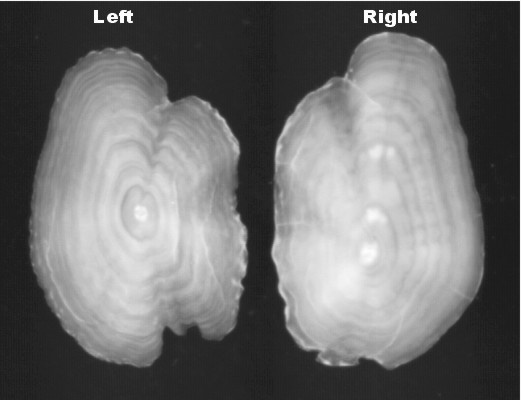
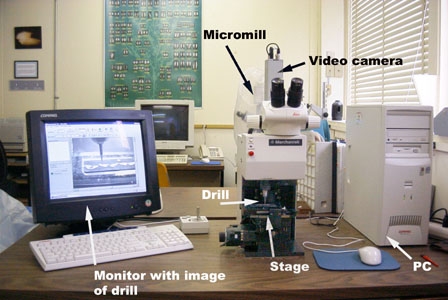
Otoliths are accretionary aragonite structures precipitated within the inner ear of most fishes. They serve a function similar to a "black box flight data recorder", by storing the daily details of life. They are the CD-ROM of the fish. If we learn the code, we can learn about that fish. I am using Merchantek micromill for descrete sampling of carbonate from the otolith on a micron scale that allows for reconstruction of temperature and other life history parameters during the life of the organism. Most of my work relates to basic issues. (I have never claimed that my research is of any immediate use, although I do hope it will be in the long run) . However, I find great pleasure in working on more applied issues as well; I have never been ashamed of my research being of practical use here and now. These applied interests have brought me into the present thesis research on stable isotopes in otoliths of plaice (Pleuronectes platessa L). This research seeks to validate classical ageing and growth studies of plaice, a European fish stock that is managed by the International Council for the Exploration of the Sea (ICES), with scientific contributions from the European Commision and Center for Environment, Fisheries and aquaculture Sciences (CEFAS). The classical approach in estimation of age of plaice and growth will be validated using stable isotopes in the rythmic banding structures of plaice otoliths. My thesis seeks to estimate age and growth variabilities of plaice ffrom the Celtic Sea and the North Sea using stable carbon and oxygen isotopes in otoliths as a validation tool for classical methods. A priliminary presentation on the classical approach in ageing and growth of plaice is available here in powerpoint , HTML and pdf. I am using the Finnigan Delta-XL Kiel carbonate device for stable isotope analysis in otoliths. I do believe that it is helpful to try to understand what has happened in the past, in preparing for what might happen in the future, fish otoliths store information from the birth of the fish, up to their death and can be used to study envirnmental regime shifts and life history parameters. For this reason, I value the existence of long-term time series - and the analysis of them. I love interacting with colleagues, and find great pleasure in team works.
The Promoters of my thesis are:
Promoter: Professor Philippe Claeys, Department of Geology, VUB, Belgium
email: [email protected]
Co-promoter: Ir Wim Demare, Sea Fisheries Department (DVZ), Oostende, Belgium
email: [email protected]
Other Scientific Reports and Presentations
The following are lists of some reports and presentations:
-
Nutrient determination in the Belgian Coastal Waters of the North Sea: presentation available in (ppt) and HTML
-
Analysis of nutrient concentration in the Spuikom lagoon, Oostende (Belgium): during a 24-hour carbon cycling. Scientific report, available in ( pdf )
-
Density and Condition Factor of Mussels(Mytilus edulis L) from an exposed and sheltered breakwater in Wimreaux(available on request
The URL of this webpage is: http://student.vub.ac.be/~shekusei/research.html
For any questions or comments, please  to:
to: 



|
SierraLeone |